
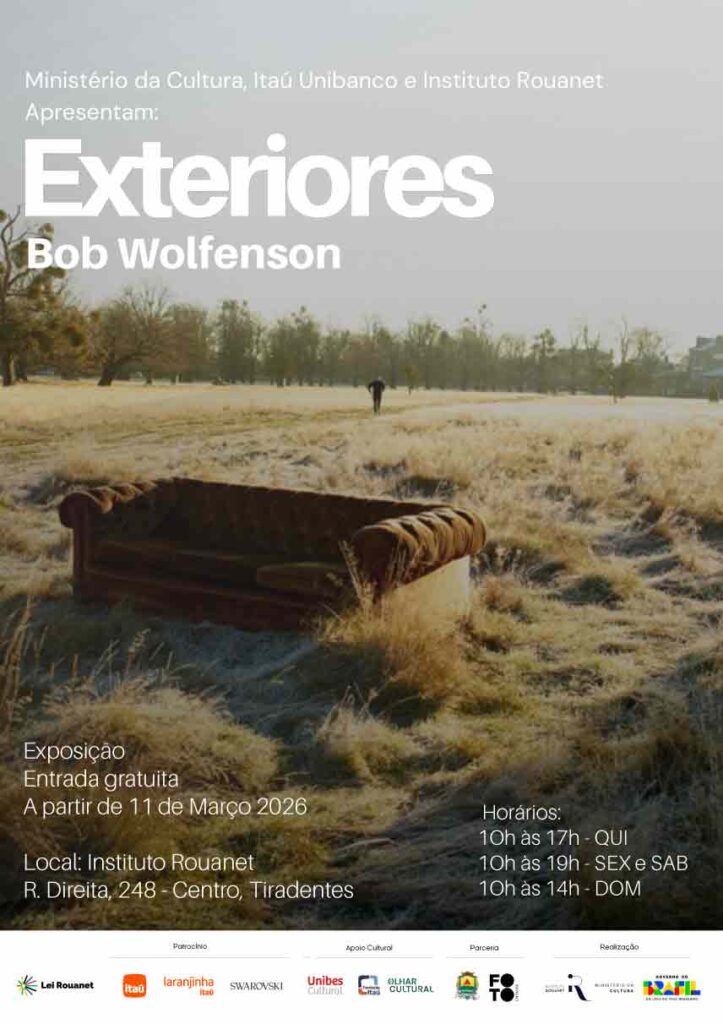
It is an honor to host the exhibition Exteriors, by Bob Wolfenson. I recognize in Bob and in his wanderings over five decades across various territories a way of seeing the city that dialogues with the thought of Barbara Freitag and Sergio Paulo Rouanet, founders of the Rouanet Institute.
If, in Rouanet’s Benjaminian reading, flânerie — or wandering without direction — provides experience and reflection, transforming the gaze of the flâneur, in Barbara Freitag the city becomes the protagonist, imposing itself as a school of life, shaping the subject through their social experience.
It is at this intersection between subjective experience and exterior spaces (and often interior ones) that Bob’s images are born, revealing the gaze of the subject behind the camera: the flâneur-photographer who discovers himself in the very act of photographing.
Adriana Rouanet
Executive and Artistic Director
Rouanet Institute
The “exterior” is not only public space, but that which escapes the photographer’s control. The curatorship takes this idea as its guiding thread: images made in the flow, without the apparatus of the studio, where observation and vulnerability meet.
The exhibition layout is not organized by city or chronology, but by a sensory path — urban solitude, waiting, displacement, shadows, passages — forming a visual diary more psychological than geographical.
Exteriors functions as a faceless self-portrait: even without the traditional portrait, it reveals the gaze — what affects, crosses, and recognizes the world.
In Tiradentes, where time rests upon stone, the photographs find another breath and walking becomes memory. Amid the silences, the portrait of Milton Nascimento emerges as permanence: a presence that concentrates time, music, and belonging.
Francisco Moreira da Costa
Co-curator
I intuit the following: those who photograph in outdoor or uncontrolled environments know that anything can be photographed — or rather, is worthy of being photographed — and that, almost always, the photographer will not know beforehand what will become the object of their interest when they are in the field.
Although I was trained in the controlled environment of a photographic studio, occasionally, throughout my trajectory, I walked through the streets of cities and along the trails of the countryside, carrying my camera on random outings, just as a writer makes notes in a notebook.
Renewed from time to time over five decades, my wandering through the world with a photographic camera, in addition to fulfilling a compulsion that characterizes me to inventory everything I see, also seeks to satisfy the curiosity I have about the geography, customs, architecture, and behavior of the places I visit, often as a fleeting traveler.
When I hold the camera, in most cases, I do not see everything that is framed and, as I walk and come across something that jumps to the eye, I hurry to record the scene, often without great technical precision. Occasionally, the result is surprising, and I find myself pondering questions such as: “Look at that guy back there looking at me; and what is that thing on the corner of the street?”.
In the end, a certain insubordination operates in the original sense of these outings, whose function of inspiration or mere search for locations ends up gaining a logic of its own. I wander around as a mere passerby and, with the advent of cellphone cameras and the incredible improvement demonstrated by them, I always have at hand something that can photograph, as well as, many times, a certain indolence toward walking around with a more professional photographic device: some images here were made with the phone!
In the course of this flânerie, I was also able to experience a certain thematic disorder, ranging from the pure snapshot taken of the passerby unaware of my camera explicitly in front of them to more precise and carefully composed images.
When revisiting these records, testimonies of my journey, I feel that I owe many of them to luck and I receive them as markers of my adventure, of the passage of time and the transformations that occurred throughout it. In any case, I am increasingly convinced that what we are given to see through the gaze of a photographer is pure fiction, contrary to what many proclaim due to the fact that photography is the most accurate form of representation of reality.
These images exhibited here are not about the places where they were photographed, but rather about a photographer who, by making them, captured such exteriors of himself.
By bringing this exhibition to Tiradentes within the scope of the Photography Festival and exhibiting in the eighteenth-century house that is the headquarters of the Rouanet Institute, once the residence of the family of the same name, I feel in tune with the Enlightenment atmosphere that is breathed here.
And the meeting of the exhibition Exteriors with the internationalist trajectory of the Freitag/Rouanet couple was not a simple coincidence; it was a choice from both sides.
I feel privileged that one of the most relevant names in Brazilian culture in recent decades hosts my exhibition through the legacy of its Institute. The name given to the law to which the entire arts and culture sector is indebted has become heritage, and I say it proudly: I am exhibiting at the Rouanet Institute.
Bob Wolfenson
Photos and Curatorship


